KW Default Solutions
A homeowner tells you, "The bank has the deed, so the bank already owns the house."
Before you build a plan around that sentence, find out which piece of paper they mean. Ask: "When you say the bank has the deed, can you show me the paperwork you mean?"
Lender paperwork often has the word "deed" in its name, like a deed of trust. That document generally secures the loan. It doesn't, by itself, make the lender the owner.
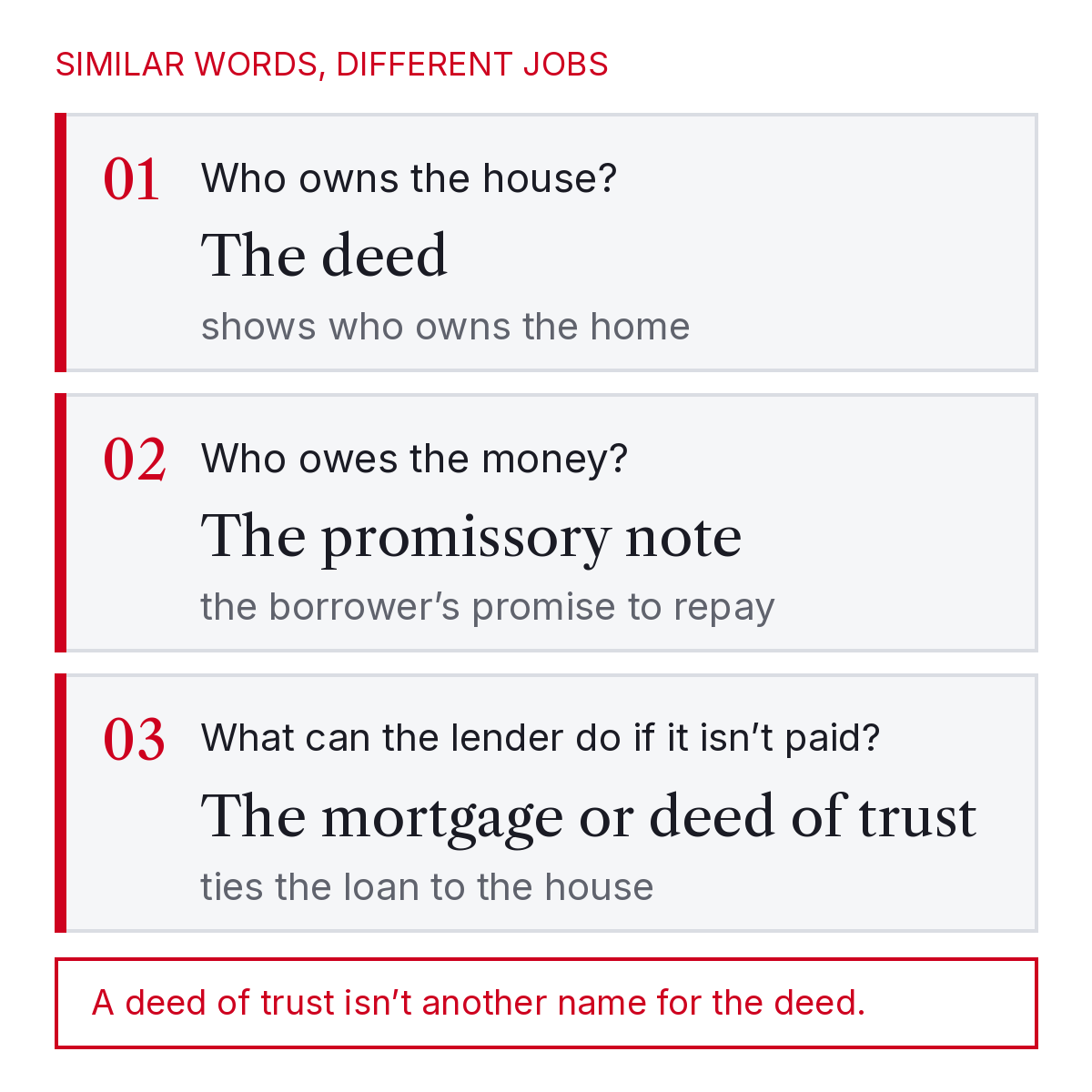
People say "the mortgage" for the whole loan. In practice, the loan usually involves three documents, and each one answers a different question. Similar words, different jobs.
Key takeaways
- Lender paperwork often has the word "deed" in its name, like a deed of trust. That document generally secures the loan. It doesn't, by itself, make the lender the owner.
- Someone can be on the deed and not on the loan, and someone can be on the loan and not on the deed.
- Your job is to spot the mismatch and send each question to the right person.
01Who owns the house?
The deed is the document that transfers ownership of a property from one person to another. It names the people involved and describes the property. When someone says "I'm on the deed," they usually mean they hold an ownership interest.
A recorded deed shows who received ownership. It doesn't show who owes the money. Someone can be on the deed and not on the loan, and someone can be on the loan and not on the deed. If a homeowner says they "signed the house over," ask which document they signed, when, and who has a copy.
02Who owes the money?
The promissory note, or just the note, is the borrower's written promise to repay the loan. It spells out the amount borrowed, the interest and the payment terms.
Generally, the people who signed the note are responsible for the debt. Putting the house in a new name doesn't automatically take anyone off the note. Also, the company that holds the note and the company that collects the payment can be two different companies. If a homeowner says someone "is off the loan," ask what paperwork shows that. Not receiving the bill isn't proof of a release. Our article on who you're actually talking to about the mortgage covers that.
03What can the lender do if it isn't paid?
The mortgage, or in some states a deed of trust, ties the loan to the house. It's often called the security instrument. Think of it as the lender's backup plan: the note says who owes the money, and this document says what the lender can do about the house if the loan isn't paid. If the loan terms aren't met, it generally gives the lender the right to foreclose, following the process your state requires.
This is where the mix-up starts. A deed of trust isn't another name for the deed. It doesn't, by itself, hand the lender ownership. Which document is used, and how foreclosure works, varies by state. Ask a local title professional which one you'll see where you work.
A missed payment, by itself, doesn't make the bank the owner, either. For what happens at foreclosure and when a property is truly bank-owned, read our foreclosure and REO articles.
04What can you find in public records?
Deeds and mortgages or deeds of trust are generally recorded with the county, so you can often find copies at the county recorder's office or online. A recorded document shows what was signed and filed. It usually can't tell you who owes what today, how much is left or whether the loan is current.
A recorded deed also may not show a later estate, trust or divorce order. Treat a recorded document as a starting point, not a finished title review. Ask title or an attorney how records work in your area before you rely on what you find.
05Match what you hear to the right document
These examples are hypothetical.
| What the homeowner saysWhat it's really about | Who confirms it |
|---|---|
| "My brother is on the deed, but only I signed the loan."Ownership and the debt can have different names | Title for who must sign a sale. Authorized loan contact for the loan. |
| "My ex took over the house."The deed may have changed. The loan may not have. | Title for ownership. Attorney for the divorce order and who is liable. |
| "My cousin makes the payments."Paying the loan isn't the same as owning or owing | Authorized loan contact for the loan. Title for ownership. |
Each of these sounds like one problem, but it's really two or three. You don't have to solve any of them on the first call. Your job is to spot the mismatch and send each question to the right person.
06Keep three lines in your notes
Before you promise anything on a file, write three separate lines:
- Ownership: who is on the deed. Verified by: ______
- Who owes the debt: who signed the note. Verified by: ______
- What secures it: mortgage or deed of trust, and whether it's recorded. Verified by: ______
Write down the source too, such as a recorded document, a title report, a payoff statement, or just what the homeowner told you. The source matters as much as the answer.
If the lines have different names, you've found a question to resolve. Don't fill the gap with a guess.
Send each question where it belongs. Title confirms ownership and who must sign. The authorized loan contact confirms the loan and payoff questions. An attorney handles liability, divorce, estate or transfer questions. This is general education, not legal advice.
On your next file, add the three lines to your notes and ask the paperwork question before you plan anything.
Questions? Ask our team through the KWDS contact form.